

You might remember the first time you wore denim—maybe it was a pair of blue jeans that made you feel confident or helped you express your identity. Denim connects people across continents and generations. Today, the denim industry sells over 1.24 billion pairs of jeans every year and shapes fashion choices for millions. Denim started as workwear but now tells stories of adventure, rebellion, and sustainability. You see denim everywhere, from movie stars in classic films to eco-friendly collections. Global Denim Storytelling explains how denim garments reflect your experiences and values.
The global denim market is projected to reach $113.66 billion by 2025.
Producing one pair of jeans can use up to 3,800 liters of water.
58% of European shoppers prefer eco-friendly denim.
Key Takeaways
Denim has evolved from workwear to a global fashion staple, connecting people across cultures and generations.
Sustainability is key in modern denim production; brands are adopting eco-friendly practices to reduce water usage and pollution.
Blue jeans symbolize rebellion and identity, playing a significant role in social movements and pop culture.
Japanese denim is renowned for its quality and craftsmanship, setting new standards in the global market.
Choosing high-quality, sustainable denim helps shape a better future for fashion and the environment.
Evolution of Denim: Origins and Innovation

Mediterranean Beginnings of Denim
You can trace the roots of denim back to Nîmes, France. In the late 1600s, weavers in this Mediterranean town tried to copy a heavy fabric from Italy. They created a strong twill fabric called “serge de Nîmes.” This name gave rise to the word denim.
Denim fabric started as a blend of wool and cotton, making it perfect for tough jobs.
The town of Nîmes became famous for this fabric, which would later shape denim history.
The fabric’s durability made it popular among workers and sailors across Europe.
Levi Strauss and the Birth of Blue Jeans
When you think about the evolution of jeans, Levi Strauss stands out. He arrived in the United States in the late 1840s and opened a dry goods business. Jacob Davis, a tailor, invented sturdy pants with metal rivets for miners.
In 1872, Davis asked Strauss to help patent this design.
On May 20, 1873, they received a U.S. patent for their riveted pants.
This date marks the official birth of blue jeans as an American garment.
Date | Event | Significance |
|---|---|---|
May 20, 1873 | Levi Strauss and Jacob Davis received a U.S. patent | Copper rivets made jeans stronger, helping them become a global staple. |
Workwear to Symbolism
You see denim jeans everywhere today, but they started as workwear for miners, farmers, and railroad workers. High-quality cotton, twill weaving, and indigo dye gave jeans their unique look and strength.
By the 1950s, movie stars like James Dean wore jeans, turning them into symbols of rebellion and youth.
In the 1960s and 1970s, activists wore denim to show unity with workers and to protest social inequality.
Designers in the 1980s brought jeans into high fashion, making them a status symbol.
Denim’s journey from a Mediterranean fabric to an American garment shows its heritage and lasting impact. The evolution of denim reflects changes in society, culture, and identity.
Global Denim Storytelling: Culture and Identity
Blue Jeans in American Pop Culture
You see blue jeans everywhere in American pop culture. Hollywood played a huge role in making jeans a global symbol. Movie stars like James Dean and Marilyn Monroe wore blue jeans on screen, turning them into a symbol of youth rebellion and freedom. When you watch classic films, you notice how blue jeans stand for defiance and individuality. In the late 1960s and 1970s, flare jeans became popular. This style, inspired by naval uniforms, showed up in the hippie counter-culture and the disco scene. Rock stars and dancers wore them, making blue jeans a sign of changing times.
“Blue jeans are more than just pants. They are a statement, a piece of history, and a part of your story.”
You might remember the return of flare jeans in the late 1990s and early 2000s. Pop icons like Britney Spears and Jennifer Lopez brought them back, showing how blue jeans adapt to new trends. Advertising also shaped denim culture. Brands like Calvin Klein and Gloria Vanderbilt used bold campaigns to make blue jeans even more popular. For example:
Sydney Sweeney’s American Eagle ad campaign sparked debate but boosted sales.
Calvin Klein’s 1980s campaign with Brooke Shields made blue jeans a fashion must-have.
Provocative ads often led to more attention and success for denim brands.
These moments show how global denim storytelling connects fashion, media, and identity. Blue jeans became a global phenomenon because they fit every generation and style.
Youth Rebellion and Social Movements
You see blue jeans as a symbol of defiance and unity in many social movements. During the Civil Rights Movement, activists wore blue jeans to show solidarity with working-class people. Members of the Student Nonviolent Coordinating Committee (SNCC) chose denim to connect with the communities they served. This act turned a fabric once linked to hard labor into a badge of pride and liberation. At the 1963 March on Washington, blue jeans stood for the struggles and hopes of the working class. Dr. Martin Luther King Jr. and Rev. Ralph Abernathy wore denim jeans when they were arrested, showing the deep link between racial and economic justice.
Denim culture also played a big part in the counter-culture of the 1960s and 1970s. Young people wore blue jeans to protest against old traditions and to demand change. The hippie counter-culture embraced jeans as a way to break free from social norms. You can see how global denim storytelling uses blue jeans to express rebellion, hope, and a desire for a better world.
Denim’s International Spread and Japanese Influence
You might wonder how blue jeans became a global symbol beyond America. After World War II, American soldiers brought denim to Japan. They traded their jeans for local goods or left them behind, and soon, Japanese people started wearing and selling blue jeans in street markets. Movies and music from the United States, along with stars like Elvis Presley, made blue jeans even more popular in Japan. Many young people saw blue jeans as a way to embrace a more relaxed lifestyle and to join a new global culture.
Japanese weavers noticed the strong fabric and began making their own denim. They added unique touches, creating a new standard for quality and style. Japanese denim became famous for its durability and character. Artisans revived traditional techniques, turning denim into an art form. By the late 1980s and 1990s, Japanese denim gained worldwide respect. International designers wanted these high-quality fabrics, and brands like Levi’s worked with Japanese makers to set new standards.
Note: Japanese denim now leads the world in quality and innovation. The blend of tradition and modern ideas shows how global denim storytelling keeps evolving.
You see how blue jeans connect people across continents. The cultural transformation of denim shows its power as a global symbol. Global denim storytelling proves that jeans are more than clothing—they are a part of your identity and the world’s shared history. The cultural reach of blue jeans continues to grow, shaping fashion and society everywhere.
Evolution of Jeans: Modern Trends and Sustainability
Designer Denim and Luxury Fashion
You see denim everywhere, from streetwear to luxury runways. Denim has shifted from workwear to a fashion statement. Today, brands like PAIGE lead the way with polished denim, luxurious cashmere, and seasonal must-haves. PAIGE focuses on fresh washes, sleek hardware, and fit-forward silhouettes. You notice that high-quality selvedge denim and Japanese selvedge denim have become symbols of status and taste. True Religion jeans once had high price points, but now you find them more accessible because of market changes and competition. This shift shows how blue jeans have moved from premium products to everyday essentials. You can spot nostalgia for the 1970s and 1990s in the return of baggy, bootcut, and flared styles. Relaxed silhouettes and comfort-focused designs have become popular, especially after the pandemic.
PAIGE offers premium denim with a focus on quality and fit.
True Religion jeans are now more affordable due to increased competition.
Nostalgic styles like bootcut and flared blue jeans are back in fashion.
Technological Advances in Denim Production
You benefit from new technology that makes denim better and more sustainable. Automation streamlines production and reduces errors. Digital printing allows for custom designs without traditional screens. Laser finishing creates trendy looks while saving water and energy. AI-driven manufacturing gives brands insights into what you want, making blue jeans more personal. Japanese selvedge denim stands out for its precision and quality, thanks to automated weaving and skilled denim artisans. You see brands using eco-friendly dyeing methods and waterless dyeing to cut down on pollution.
Automation and AI improve efficiency and quality denim production.
Laser engraving and 3D knitting reduce waste and create seamless garments.
Waterless dyeing and closed-loop systems save water and energy.
Sustainability Challenges and Innovations
You face big challenges with traditional denim production. Making one pair of blue jeans uses about 3,781 liters of water and releases up to 30 kilograms of CO2. Denim factories can pollute rivers and groundwater. About 20% of global industrial water pollution comes from textile dyeing and finishing. Brands now use recycled cotton fibers, organic cotton, and safer dyes to lower their impact. Water-saving techniques like foam dyeing and closed-loop machines help conserve resources. Levi’s Water<Less strategy cuts water use by up to 96%. Many brands now focus on ethical supply chains and better labor practices. You see a strong demand for eco-friendly denim, with 58% of European shoppers preferring sustainable options.
Innovation Type | Impact on Water Usage | Impact on Energy Usage |
|---|---|---|
Hydrogel Treatment | Minimal water needs | Greatly lessened |
Water Recycling | Reduced consumption | Optimized processes |
Oxygen-rich Baths | Near-zero water usage | Lower energy demand |
Digital Polymer Dyeing | Reduced waste | Improved efficiency |
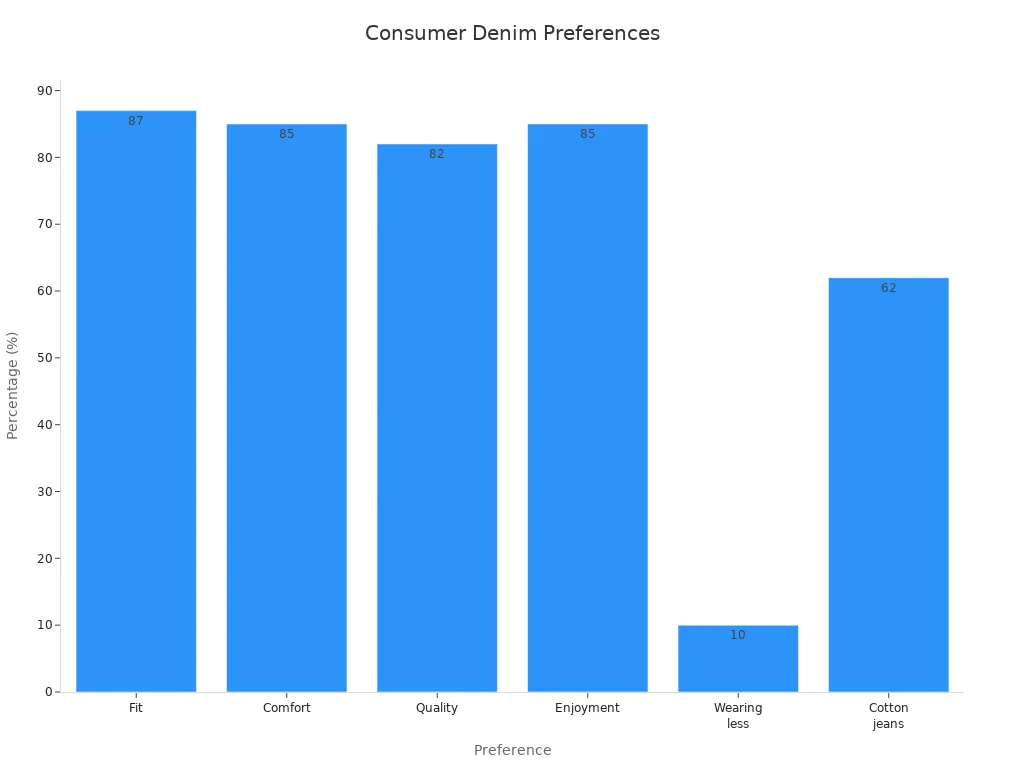
You play a key role in shaping the future of blue jeans by choosing quality denim and supporting sustainability. Japanese selvedge denim and high-quality selvedge denim set new standards for eco-friendly fashion. Denim artisans continue to innovate, making sure denim remains both stylish and responsible.
You see blue jeans shaping fashion and personal identity around the world. Denim adapts to new trends and values, showing rare cultural authority.
Blue jeans help you express a distinct identity, whether you join a movement or follow a style.
Brands now focus on sustainability, using recycled materials and waterless dyeing.
Campaigns like American Eagle and The Gap show how blue jeans reflect both personal and collective stories.
Experts predict blue jeans will keep growing in popularity as you choose comfort, durability, and eco-friendly options.
FAQ
What makes denim different from other fabrics?
Denim uses a twill weave, which gives it strength and a unique diagonal pattern. You notice denim feels sturdy and lasts longer than most other fabrics.
How can you care for your jeans to make them last?
Wash jeans inside out in cold water.
Avoid using bleach.
Air dry to prevent shrinking.
Tip: You keep jeans looking new by washing them less often.
Why do people choose Japanese selvedge denim?
Japanese selvedge denim stands out for its quality and craftsmanship. You get a tighter weave and richer color. Many denim fans prefer it for its durability and unique texture.
Are there eco-friendly options for denim?
Option | Benefit |
|---|---|
Organic cotton | Less pesticide |
Recycled fibers | Saves resources |
Waterless dyeing | Reduces waste |
You find many brands now offer sustainable denim choices.