
You can see how AI changes the way you find and select fabrics for eco-friendly fashion. Many brands struggle with problems like poor data, unclear labels, and hard-to-track materials. AI helps you solve these issues by giving better supply chain transparency and smart suggestions for greener choices. The market for AI in fashion grows fast, with 75% of executives making it a top priority.
Statistic Description | Value | Year |
|---|---|---|
AI in fashion market growth | $1.26 billion to $1.77 billion | 2024 to 2025 |
Fashion executives prioritizing AI for various functions | 75% | 2025 |
Top digital supply-chain investment priorities | AI and generative AI | 2024 |
You can use AI for dynamic fabric sourcing to boost sustainability and make smarter design decisions.
Challenge | AI Solution |
|---|---|
Lack of high-quality, transparent data | Optimizes design and production processes, enhancing supply chain transparency. |
Difficulty in assessing sustainability impacts | Analyzes environmental impacts and recommends greener alternatives. |
Inconsistent labeling and limited traceability | Models complex end-of-life scenarios to improve recyclability predictions. |
Key Takeaways
AI enhances fabric sourcing by providing real-time data and smart recommendations, helping brands make eco-friendly choices.
Dynamic fabric sourcing allows for quick adaptation to trends, reducing waste and improving sustainability in fashion design.
Using AI tools can significantly lower production waste, emissions, and resource use, leading to a more efficient and responsible fashion industry.
Integrating AI with existing systems improves supply chain transparency, enabling better tracking of materials and ethical sourcing practices.
Adopting AI-driven solutions can accelerate the design process, reduce sample waste, and support the creation of sustainable clothing collections.
Dynamic Fabric Sourcing and Sustainability

What Is Dynamic Fabric Sourcing?
You can use dynamic fabric sourcing to find and select materials quickly and efficiently. This approach lets you adapt to changing trends and supply chain conditions. You do not rely on static lists or outdated catalogs. Instead, you access real-time data and AI-powered recommendations. Dynamic fabric sourcing helps you discover new sustainable options and avoid waste. You can compare suppliers, check certifications, and choose materials that meet your design needs.
Why Sustainability Matters in Fashion
You see the impact of conventional fabric sourcing every day. The fashion industry faces serious environmental challenges:
Pollution and resource depletion threaten ecosystems.
Harmful chemicals in textile production risk the health of workers and communities.
Synthetic fiber extraction uses a lot of energy and damages the environment.
Cotton farming contaminates waterways and harms farming communities.
High water usage in garment production causes groundwater depletion.
When you prioritize sustainable materials, you help reduce these problems. Fashion brands like Patagonia, Reformation, and Eileen Fisher show how sustainable fabrics, efficient production, and circular practices make a difference. You can choose biodegradable textiles, vegan leathers, and recycled materials to support sustainability.
AI’s Role in Sustainable Material Selection
AI gives you powerful tools for sustainable material selection. You can analyze carbon footprint, water usage, chemical impact, and recyclability. AI benchmarks sustainability claims and verifies certifications. You compare suppliers based on their sustainable offerings and ethical practices. AI sorts and identifies materials for recycling, improving rates for complex blends. You receive suggestions for sustainable alternatives that meet your performance needs. Tools like Fairly Made’s Ecodesign let you assess and improve your designs in real time. Brands such as Levi’s and SXD use AI to create zero waste designs and rapid prototypes. You can follow their lead and use dynamic fabric sourcing to boost sustainability in your own collections.
AI Clothing Design and Material Matching

Setting Design Requirements
You start your ai clothing design process by setting clear design requirements. This step guides your fabric selection and ensures your project meets sustainability goals. You must consider several key factors before you let AI match materials to your needs.
Description | |
|---|---|
Validation of Structures | You need to validate the stability and feasibility of the generated materials. |
Computational Resources | You require significant computational resources because AI models run many iterations. |
Quality of Training Data | The performance of ai clothing design depends on the quality and diversity of training data. |
You can use platforms like Greenstitch to track emissions and automate carbon calculations. This helps you set reduction targets for your designs. Refiberd uses AI to classify used garments for recycling, while Circ applies AI in chemical recycling to recover materials from blended textiles. Virtual sampling tools such as CLO 3D allow you to create digital prototypes. This reduces waste and speeds up your design process. AI can cut sample development time by up to 50 percent, lowering emissions from physical prototypes and material use.
Tip: You should combine AI with blockchain and IoT sensors to achieve end-to-end traceability of materials. This ensures your designs comply with sustainability standards.
Using AI to Match Sustainable Materials
You rely on ai clothing design to match sustainable materials with your specific design needs. Machine learning algorithms optimize fabric selection by recognizing patterns and finding low-carbon alternatives. AI transforms the materials selection process into a data-driven recommendation system. It analyzes databases that include carbon footprints and performance characteristics.
You input product specifications into a computational lifecycle assessment platform.
The platform calculates environmental impacts across all lifecycle stages.
AI evaluates design variations to optimize packaging and reduce environmental impact.
You can use ai clothing design to accelerate the discovery and synthesis of new materials. Machine learning-based force fields offer a cost-effective alternative to traditional methods. Generative models propose new materials and synthesis routes, making your fabric selection more efficient. You improve design accuracy by letting AI evaluate various options and recommend the best sustainable fabrics.
You also benefit from real-time inventory monitoring. AI helps you manage supply chains efficiently and reduces carbon emissions from logistics. You ensure your designs use materials that meet both performance and sustainability standards.
Predicting Trends with AI
You use ai clothing design to predict upcoming fabric trends in sustainable fashion. AI systems like Zara’s analyze millions of social media posts and consumer behaviors. This helps you identify emerging trends in fabric selection before traditional methods can. AI detects shifts in color preferences, style elements, and fabric choices. Sentiment analysis guides you toward fabrics that consumers will likely adopt.
AI processes vast amounts of market data to spot new trends.
You receive insights on color, style, and sustainable fabric selection.
You adjust your designs quickly to match consumer demand.
Heuritech reports that AI-driven trend forecasting in sustainable fashion reaches an accuracy rate of 90 percent. You can trust ai clothing design to guide your choices and keep your collections relevant. You stay ahead of the curve and make informed decisions about fabric selection and design.
Note: You should use ai clothing design to visualize your designs and test new materials virtually. This reduces waste and supports sustainable practices.
You see how ai clothing design supports every step of your process. You set requirements, match sustainable materials, and predict trends with confidence. You improve your design accuracy and make better choices for the environment.
Steps for AI-Driven Sustainable Production
Inputting Criteria into AI Platforms
You begin your journey toward sustainable production by preparing your data for AI platforms. Clean and organize your supplier information. Make sure you use consistent categories for spending. This step helps you avoid confusion and errors later. Break down data silos between your ERP systems, sourcing tools, and contract files. When you connect these systems, you create a single source of truth for your sourcing decisions.
Set clear rules for who can access and use your data. This keeps your information safe and ensures you follow regulations. Collect high-quality data from your main suppliers. You also need to gather secondary data, such as average emissions for your industry. Use data analytics to spot new sourcing opportunities and check how your suppliers perform.
Tip: Focus on emission hotspots in your supply chain. This helps you target the biggest sources of environmental impact.
Follow these steps to input your criteria into AI platforms:
Clean and categorize your supplier data.
Connect all your sourcing and contract systems.
Set data access policies for compliance.
Identify emission hotspots to guide your actions.
Assess the total cost of ownership for better decisions.
AI platforms often require different types of sustainability data. The table below shows the most common data types you will use:
Data Type | Description |
|---|---|
Predictive modeling systems | Analyze sustainability trends and emissions patterns, helping you forecast future emissions. |
Scenario simulation models | Anticipate risks from regulatory changes and supply chain disruptions. |
Optimization algorithms | Refine your sustainability strategies through continuous learning from new data. |
Document processing and NLP | Extract insights from sustainability reports and ESG disclosures for compliance. |
Real-time sensor data analysis | Process IoT inputs to find inefficiencies in energy use and waste management. |
Evaluating AI-Recommended Materials
After you input your criteria, AI platforms suggest materials that match your goals. You need to evaluate these recommendations carefully. Look at both environmental and quality indicators. Use the following table to guide your assessment:
Description | |
|---|---|
Climate change | Measures the impact on global warming. |
Fine particle emissions | Assesses the release of particulate matter into the air. |
Water resource depletion | Evaluates the reduction of available freshwater resources. |
Exhaustion of non-renewable fossil and mineral resources | Analyzes the depletion of finite natural resources. |
Land use | Examines the impact on land availability and usage. |
Ozone depletion | Measures the reduction of the ozone layer. |
Photochemical ozone formation | Assesses the creation of ground-level ozone from pollutants. |
Soil acidification | Evaluates the increase in soil acidity due to pollutants. |
Ionizing radiation | Measures exposure to radiation that can cause harm. |
Terrestrial, marine and freshwater eutrophication | Assesses nutrient overload in ecosystems leading to harmful algal blooms. |
Human carcinogenic and non-carcinogenic toxicity | Evaluates the potential health risks to humans from materials. |
Freshwater eco toxicity | Measures the impact of materials on freshwater ecosystems. |
Overall Score | A single score representing the environmental impact, guiding your sourcing and production adjustments. |
You also need to check the quality and sustainability of each fabric. The next table lists important metrics:
Metric | Description |
|---|---|
Eco-friendly indicators | Assess the use of energy-efficient machinery, reduction of toxic chemicals, and closed-loop systems. |
Carbon footprint reduction | Monitor greenhouse gas emissions and find ways to lower them. |
Water usage efficiency | Evaluate and reduce water consumption through recycling and new technologies. |
Energy consumption | Track energy use across production stages to find areas for improvement. |
Ethical sourcing | Ensure fair labor practices and sustainable farming methods in your supply chain. |
You should always look for verified environmental data. Check for material-specific insights on water use, carbon footprint, and chemical management. This helps you avoid material waste and choose the best options for your brand.
Integrating Fabrics into Production
Once you select your materials, you need to bring them into your production process. Start by collecting information on material properties, energy use, and waste generation. Use IoT sensors and past data to get accurate numbers. Let AI analyze your workflow to find inefficiencies. Change machine settings or adjust schedules to reduce material waste and improve resource use.
Choose eco-friendly materials, such as recycled metals and renewable fibers, whenever possible. Set up predictive maintenance for your equipment. This prevents breakdowns and keeps your production running smoothly. Use AI to forecast demand. This helps you avoid overproduction and supports on-demand production, which lowers inventory risks and environmental impact.
Note: Industry 4.0 brings smart manufacturing to fashion. AI and automation help you make better decisions and reduce waste.
Keep improving your process. Create a feedback loop to measure performance and find new ways to save resources and cut emissions. AI acts as your partner in sustainable production. It helps you optimize design, reduce sampling waste, and shift toward more responsible manufacturing.
You can see how these steps help you build a more efficient and eco-friendly workflow. You reduce material waste, lower costs, and support a cleaner planet.
Benefits, Challenges, and Tools
Key Benefits of AI in Fabric Sourcing
You gain many advantages when you use ai sustainable fashion solutions for sourcing clothing materials. AI helps you reduce fabric waste, save water, and cut chemical use. You see productivity gains in mills and factories. The table below shows the impact of these tools on clothing production:
Result Description | Quantitative Impact |
|---|---|
Reduction in fabric waste through AI design tools | |
Reduction in water and chemical use in dyeing and finishing | Significant savings |
Productivity gains from AI-augmented sensors in mills | Nearly 20% |
Reduction in fabric waste during cutting with advanced algorithms | |
Annual savings for small factories using optimized cutting layouts | Tens of thousands of dollars |
Reduction in scrap material during cutting | Up to 20% |
AI also improves transparency and traceability. You can track every step in the clothing supply chain. You make better decisions about personalized clothing and customization. You speed up the customization process and bring clothing to market faster. You also see less sample waste and more reuse of materials.
Overcoming Common Challenges
You may face some challenges when you adopt ai sustainable fashion tools. These include:
Bias and blind data from incomplete supplier information.
Integration nightmares when connecting AI with old systems.
The black box problem, where you cannot explain AI decisions.
You can overcome these obstacles by taking a systematic approach. Start with manageable use cases. Scale your solutions step by step. Invest in employee training to build skills. Work with experienced AI partners. Refine your strategies as your needs change. This helps you build trust and improve transparency in your clothing operations.
Practical Tips and Recommended Tools
You can maximize the benefits of ai sustainable fashion by following these tips:
Instantly convert text or images into production-ready patterns.
Automatically generate 3D garment simulations to reduce sample iterations.
Use fabric-efficient design suggestions to cut material waste.
Apply auto-optimized marker layouts for less waste.
Calculate fabric usage to avoid overproduction.
Integrate seamless traceability to track materials and processes.
You can use leading AI tools to support your clothing sourcing and customization. The chart below compares features of top platforms:
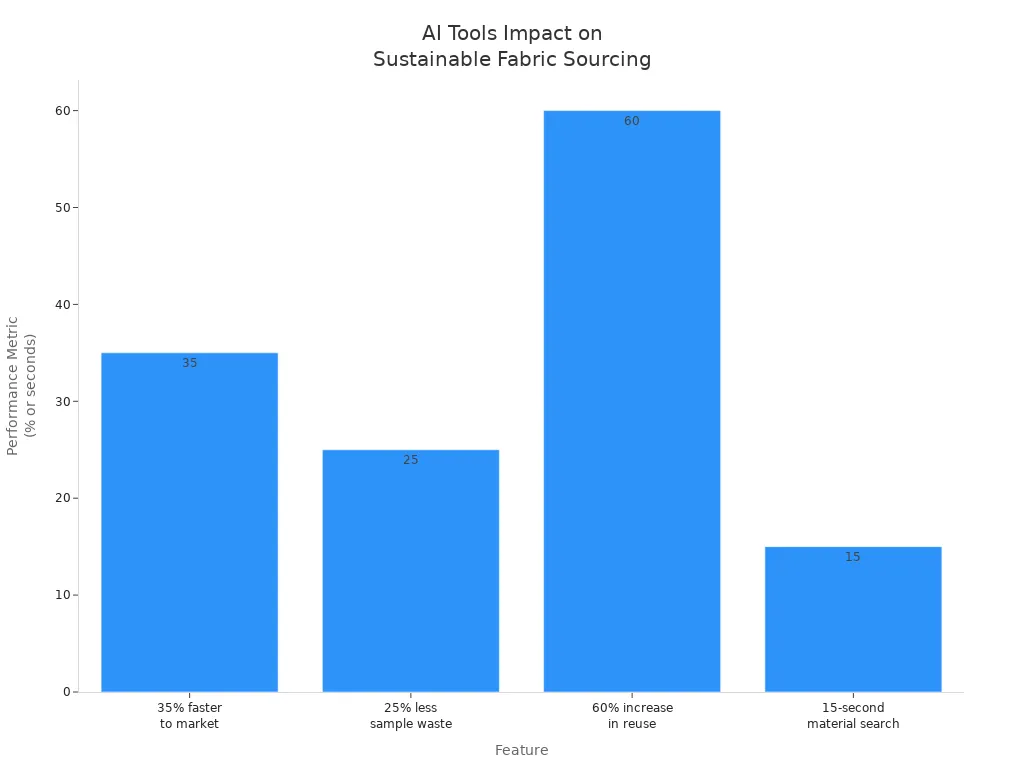
Feature | Benefit |
|---|---|
Real-Time Collaboration | Keeps teams and suppliers in sync |
AI-driven sourcing efficiency | |
25% less sample waste | More effective reuse and refinement |
60% increase in reuse | Maximizes existing materials usage |
15-second material search | Quick access across libraries |
Built-in live inventory | Enhances transparency in sourcing |
You can try Browzwear for 3D design and less waste. Aloqia helps you find deadstock fabrics for sustainable sourcing. Supplycompass offers end-to-end product development with AI integration. These tools support transparency, customization, and personalized clothing for your brand.
Tip: Use AI to improve transparency and efficiency in every step of your clothing production. This helps you meet your sustainability goals and deliver personalized products.
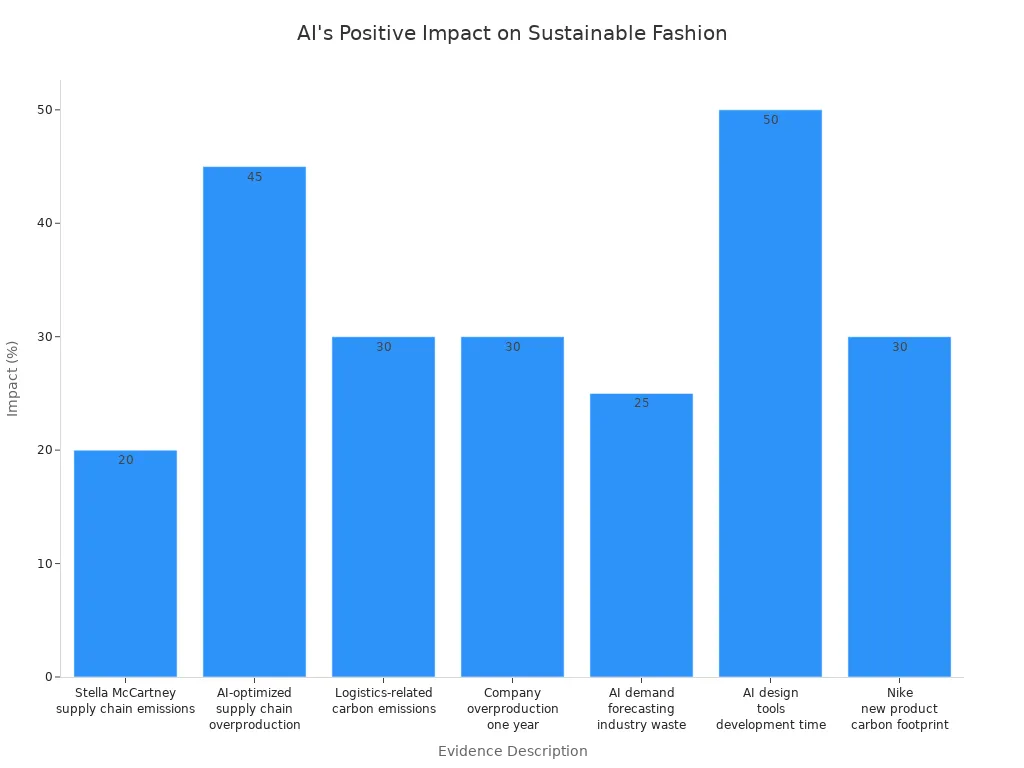
You see how AI transforms fabric sourcing and sustainable fashion. AI streamlines production, reduces waste, and boosts supply chain transparency. You can start by defining your design needs or testing platforms like SketchAI and Revery. The table below shows how AI reduces emissions, waste, and production time in fashion.
Description | Impact |
|---|---|
Supply chain emissions | ↓ 20% |
Overproduction | ↓ 45% |
Logistics carbon emissions | ↓ 30% |
Product development time | ↓ 50% |
Fashion industry waste | ↓ 20-30% |
Nike’s new product line carbon footprint | ↓ 30% |
Tip: You can use generative AI tools to create faster prototypes and improve traceability. This helps you make smarter, greener choices for your brand.
FAQ
How does AI improve fabric sourcing in fashion?
You use ai to analyze supplier data and predict material availability. This helps you find eco-friendly materials faster. Ai also checks certifications and tracks the environmental impact of each fabric. You make better choices for sustainable design and circular fashion.
Can AI help you design for circular fashion?
Yes, ai supports circular fashion by suggesting recyclable fabrics and tracking material lifecycles. You use ai to plan for reuse and recycling. Ai also helps you select eco-conscious options and reduce waste in your production process.
What role does 3D simulation play in sustainable design?
You use 3d simulation to visualize garments before production. Ai-powered simulation lets you test fabric performance and fit. This reduces sample waste and supports eco-conscious decisions. You see the environmental impact of your choices before making them real.
How does AI support ethical sourcing and transparency?
Ai checks supplier practices and verifies certifications. You use ai to monitor labor standards and material origins. This ensures ethical sourcing and supports your eco-conscious goals. Ai also helps you track every step in your supply chain.
Why should you use AI for eco-friendly materials selection?
You use ai to compare the environmental impact of different fabrics. Ai recommends eco-friendly materials based on your design needs. This helps you lower emissions and support sustainable design. Ai also speeds up your search for the best options.