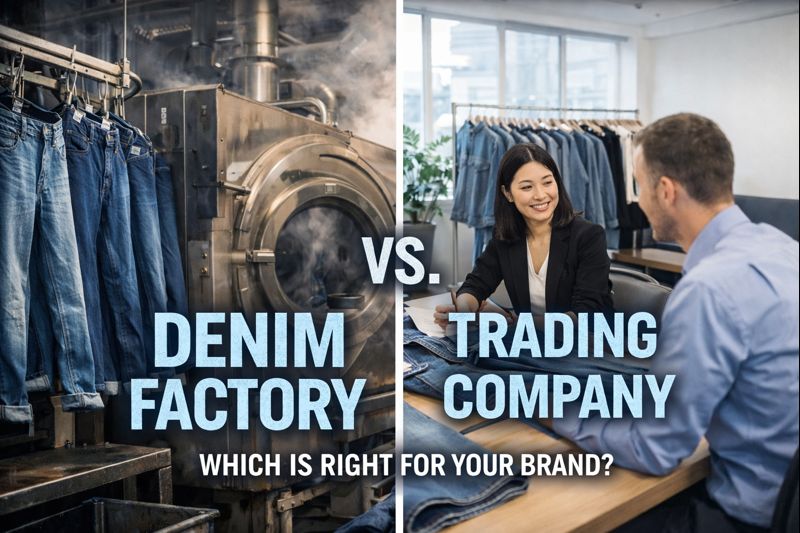
You want to build a denim brand that stands out. Your choice between a denim factory and a trading company shapes your control, cost, and quality. Some brands prefer direct access to production for Color Matching Guaranteed results, while others value flexibility and lower risk. Think about what matters most to your business as you decide which path supports your goals.
Key Takeaways
Choose a denim factory for greater control over production. This allows you to oversee quality and customization, ensuring your brand stands out.
Consider a trading company if you need flexibility and convenience. They can manage logistics and communication, making it easier to enter new markets.
Larger orders with factories often lead to lower prices. Take advantage of economies of scale to save money on production costs.
Always ask about sustainability practices. This helps you align your brand with responsible fashion and meet customer expectations.
Evaluate your brand’s size and experience. Smaller brands may benefit from trading companies, while established brands can negotiate better terms with factories.
Denim Factory vs. Trading Company: Key Differences
Production Control
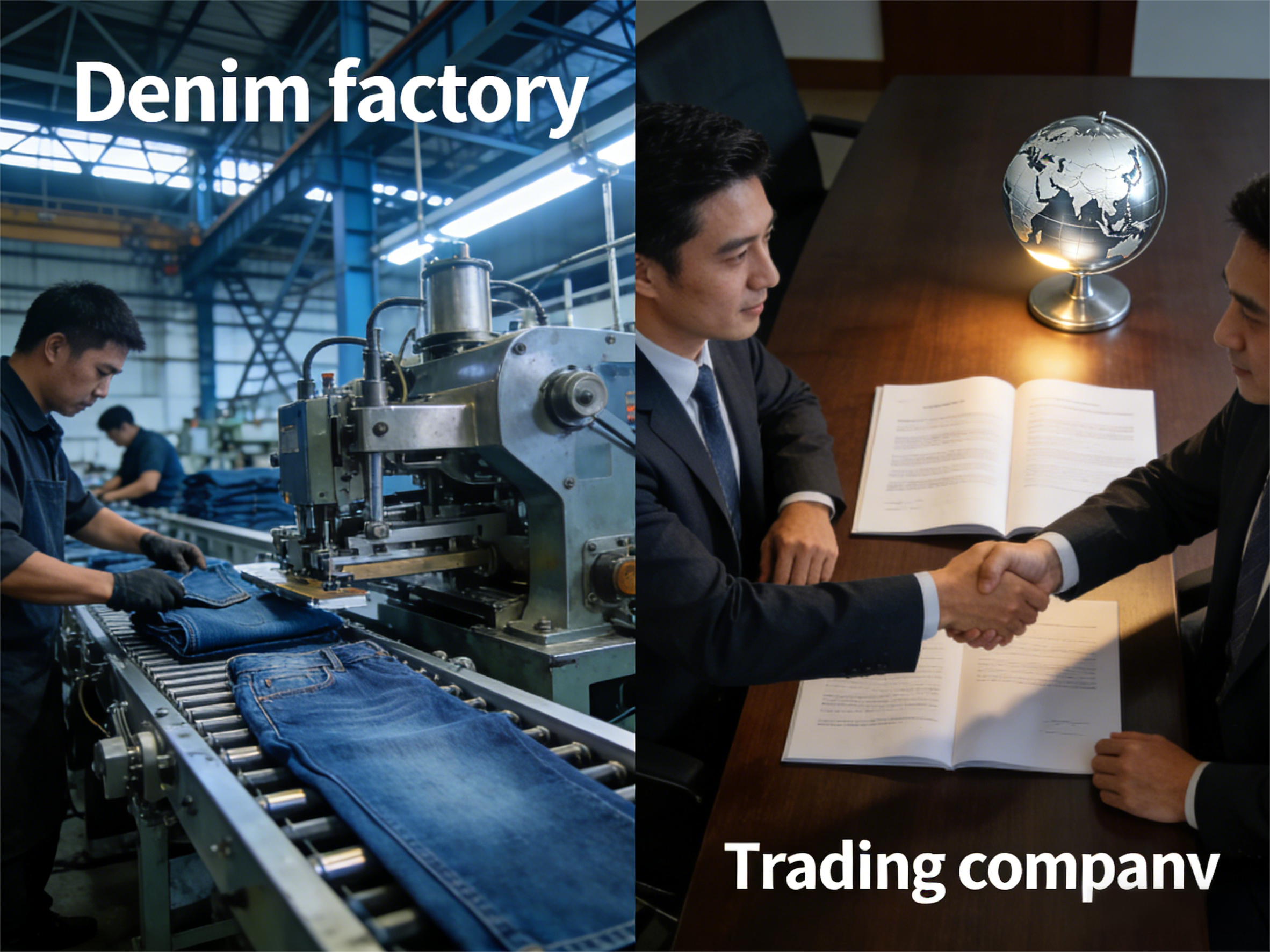
You gain the most control over your product when you work directly with a denim factory. This means you can oversee every step, from fabric selection to final stitching. Factories often let you visit the production floor or request detailed updates. You can set your own quality standards and make sure workers follow them. In the denim industry, this level of control helps you maintain consistency and build trust with your customers.
Trading companies act as middlemen. They manage communication between you and the factory. You may not have direct access to the production line. This can limit your ability to monitor quality or make quick changes. However, trading companies often have relationships with several factories. They can switch suppliers if problems arise, which adds flexibility but reduces your direct influence.
Customization Options
Factories usually offer more customization. You can choose fabric weights, washes, trims, and even request unique finishes. Many factories in the denim industry invest in new technology for sustainable dyeing and eco-friendly treatments. This helps you create products that stand out and meet modern environmental standards.
Trading companies can also provide customization, but options may be limited by their partner factories’ capabilities. They might not offer the latest innovations or sustainable practices. If you want to launch a unique collection or experiment with new trends, working directly with a factory gives you more freedom.
Pricing Structure
Pricing in the denim industry depends on order size and supplier type. Factories often offer better prices for large orders because you skip the middleman. You also benefit from economies of scale. The following table shows how average cost per unit drops as your order size increases:
MOQ Tier | Avg. Cost/Unit | Notes |
|---|---|---|
< 300 units | $18–$25 | High due to inefficiencies |
500–1,000 units | $10–$15 | Moderate discount, still flexible |
3,000–10,000 | $7–$10 | Economies of scale start to apply |
10,000+ units | $6–$8 | Best pricing, factory priority given |
For example, a Canadian startup ordered 200 units at $19 each. When they reordered 1,500 pieces, the price dropped to $11.30 per unit. This shows how larger orders can save you money.
Trading companies may charge higher prices because they add their own margin. However, they can sometimes negotiate better rates for small brands by pooling orders from multiple clients. This helps you access factories that usually require high minimums.
The table below compares minimum order quantities (MOQs) and costs in different regions:
Factory Type | Region | MOQ per Style | Cost per Pair (USD) |
|---|---|---|---|
Boutique Workshop | USA/Europe | 30–50 | $35–$60 |
Mid‑Size Factory | USA/Europe | 100–200 | $20–$35 |
Large Production Plant | China/Bangladesh | 300–500 | $15–$25 |
Communication Flow
Direct communication with a denim factory gives you faster answers and more accurate updates. You can solve problems quickly and avoid misunderstandings. This is important in the denim industry, where timing and details matter.
Trading companies handle all communication for you. This can save you time, especially if you face language barriers or time zone differences. However, messages may get delayed or lost in translation. You might wait longer for answers or see mistakes in your orders. If you value speed and clarity, direct factory contact works best. If you prefer a hands-off approach, a trading company can simplify the process.
Tip: Always ask about sustainability practices and quality certifications, whether you choose a factory or a trading company. These factors set your brand apart in the denim industry.
Pros and Cons for Your Brand
Denim Factory: Advantages
You gain several benefits when you work directly with a denim factory. The table below highlights the most significant advantages brands report:
Advantage | Description |
|---|---|
Consistency in Quality | Every batch meets the same standards, keeping launches on schedule and customers satisfied. |
True Customization | Factories can accurately translate your designs from digital artwork to final garments. |
Compliance Certifications | You protect your brand reputation with guaranteed compliance. |
Agile Minimum Order Quantities | Flexible order sizes help you maintain healthy cash flow. |
Transparent Lead Times | Clear timelines prevent excess stock and waiting periods. |
Intellectual Property Protection | Strict privacy protocols safeguard your designs. |
You also experience greater transparency in production. You see how your denim gets made and track every step. Factories often invest in innovation, bringing new washes, sustainable materials, and eco-friendly processes to your brand.
Denim Factory: Disadvantages
You may face challenges when partnering with a denim factory. These include:
Pressure from changing regulations and consumer demand for sustainability.
Operational overload due to inconsistent standards across brand partners.
Difficulty scaling recycled cotton because of different certification bodies.
Sustainability concerns if factories do not use eco-friendly materials.
Traceability issues from unclear definitions and standards.
Staff time lost to duplicate data entry.
Audit fatigue from unsynchronized review cycles.
Capital at risk from technology investments tied to uncertain orders.
You must stay alert to these risks and maintain transparency with your partners. Sometimes, factories struggle to keep up with innovation, especially when requirements change quickly.
Trading Company: Advantages
Trading companies offer you flexibility and convenience. You can access multiple suppliers without managing each relationship yourself. If you want to test new styles or enter new markets, trading companies help you adapt quickly. They often handle language barriers and logistics, saving you time. You benefit from pooled orders, which can lower minimums and open doors to factories focused on innovation.
Trading companies also provide transparency in sourcing, as they track orders and share updates. You can focus on growing your brand while they manage the details.
Trading Company: Disadvantages
You may encounter drawbacks when working with trading companies:
Brands often shift tariff costs to suppliers, increasing financial pressure.
Suppliers may cut corners on quality, working conditions, or environmental standards.
Cost absorption can lead to reduced wages or layoffs, affecting communities.
Trust and collaboration between brands and suppliers may weaken, risking supply chain resilience.
You lose some transparency in production, which can make it harder to guarantee quality. Trading companies may not always prioritize innovation, especially if they work with factories that use older methods.
Decision Factors: Finding the Right Fit
Brand Size & Experience
Your brand’s size and experience shape your sourcing strategies. If you run a startup or a small label, you may need low minimum order quantities and quick market entry. Factories in China often accept orders as small as 30 pairs, while American factories usually require at least 500 pieces per style. Sourcing denim from china gives you access to a wide range of suppliers, making it easier to test new products and scale up as your brand grows. Larger brands with established processes can negotiate better terms and may benefit from direct factory relationships, especially when seeking responsible denim options and greater control.
Tip: Sourcing diversification helps you manage risk and adapt to supply chain shifts. Consider working with both factories and trading companies to balance cost, quality, and flexibility.
Control & Customization Needs
You need to decide how much creative control and customization your brand requires. Denim factories offer two main models: OEM (Original Equipment Manufacturer) and ODM (Original Design Manufacturer). The table below shows how each model affects your options:
Feature | ODM (Trading Company or Factory) | |
|---|---|---|
Creative Control | Total flexibility in designs, fabrics, and methods | Uses pre-existing designs with some customization |
Investment | Higher initial investment for design and development | Lower initial costs, faster turnaround |
Speed to Market | Longer lead times due to custom development | Quicker production with validated processes |
Ideal For | Brands needing unique designs and full control | Brands with time and budget constraints |
If you want to launch a collection with unique washes or trims, direct factory sourcing gives you more flexibility. Trading companies can help you move faster, but may limit your ability to innovate. Sourcing denim from china often provides high customization flexibility, especially for small batches.
Budget & Cost Efficiency
Your budget plays a major role in choosing between a factory and a trading company. Factories usually offer lower prices for large orders, while trading companies add service fees but provide convenience. Consider these points:
Factories typically provide lower prices than trading companies, especially for larger orders.
Trading companies offer additional services and convenience, which can justify their higher prices.
Minimum order quantities and pricing structures differ significantly between small and large orders, affecting overall cost efficiency.
LCL (Less than Container Load) is more economical for small orders but incurs a higher per-unit freight cost.
FCL (Full Container Load) is recommended for large-volume orders, providing better cost efficiency.
Sourcing denim from china allows you to choose between LCL and FCL shipping, depending on your order size. American-made denim costs more per unit, but may offer higher quality and innovation. Responsible denim options often come with a premium, but can strengthen your brand’s reputation.
Lead Times & Flexibility
Lead times and flexibility impact your ability to respond to market trends. The table below compares standard and custom order timelines:
Parameter | ODM Partner (Trading Company) | |
|---|---|---|
Sampling Lead Time | 3–5 weeks | 2–3 weeks |
Bulk Production Time | 8–12 weeks | 6–8 weeks |
Rush Surcharge | +10–20% | +10–20% |
Factories may take longer to develop custom samples, but offer more flexibility in design changes. Trading companies can speed up the process by using pre-validated designs. Sourcing denim from china gives you access to suppliers who can handle both quick turnarounds and complex customizations. American factories often require longer lead times, but may deliver innovative products that set your brand apart.
Note: Flexibility is key when adapting to supply chain shifts. Choose partners who can adjust production schedules and order sizes as your needs change.
Risk & Quality Assurance
You must consider risk and quality assurance when selecting your sourcing strategies. Denim factories and trading companies use different quality control measures. The table below outlines typical practices:
Quality Control Stage | Measures Implemented |
|---|---|
Incoming Fabric Inspection | GSM & Weave Density checks, shade matching under D65 lighting |
First-Article Garment Approval | Fit samples, seam strength tests, stitch density checks |
In-Line Production Checks | Inline QC stations, operator self-checks |
Pre-Shipment Final Audit | AQL sampling, lab testing for wash, shrinkage, and colorfastness |
Digital QC Reporting & Transparency | Real-time dashboards, photo/video evidence for each batch |
Factories often provide more transparency and direct access to quality data. Trading companies may offer digital reporting, but you rely on their communication with the factory. Sourcing denim from china requires careful vetting of suppliers to ensure consistent quality. American-made denim stands out for innovation and strict quality standards, but costs more and may limit flexibility.
The denim industry is changing fast. Technology, sustainability, and consumer preferences drive new trends. AI, automation, and circular denim are shaping the future. Sourcing diversification and responsible denim options help you stay ahead in a competitive market.
Quality and Customization: Color Matching Guaranteed
Quality Standards
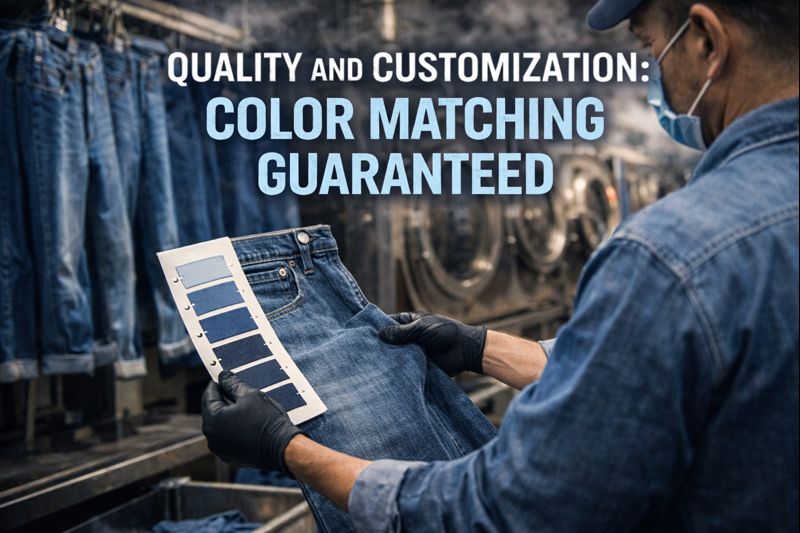
You want your denim brand to stand out for quality and reliability. Color matching guaranteed is a promise that helps you build trust with your customers. When you work with a factory or trading company, you should ask about their quality control measures. These steps help you avoid problems like uneven colors or weak fabrics. The table below shows the most common quality standards in denim manufacturing:
Quality Control Measure | Description |
|---|---|
Inspect Fabric Weight and Thickness | Ensures uniformity to avoid fit issues, targeting weights from 8.44–12.79 oz/yd². |
Test Stretch Recovery Performance | Checks elasticity with recovery rates above 90% after stretching. |
Check Colorfastness | Uses washing tests to keep denim vibrant, with dry rubbing standards at level 3-4 or higher. |
Detect Defects Early | Finds holes, stains, or weaving problems using visual and automated tools. |
Evaluate Tensile Strength | Measures how well the fabric resists pulling forces for durability. |
Assess Shrinkage Resistance | Tests to keep post-wash changes within ±3%. |
Verify Fabric Texture | Ensures a smooth feel that matches customer expectations. |
Conduct Durability Tests | Simulates wear and tear, aiming for abrasion resistance of at least 17,000 revolutions. |
Review Supplier Certifications | Confirms compliance with denim fabric certification standards. |
Implement Lean Principles | Reduces waste with just-in-time production and ongoing improvements. |
You should look for suppliers who use these standards. This helps you deliver color matching guaranteed results and durable denim that lasts.
Customization and Trend Innovation
Customization lets you create denim that matches your brand’s style and values. Color matching guaranteed technology helps you keep colors consistent across batches and suppliers. Digital systems use spectral data to make color choices objective, so you avoid mistakes caused by human judgment. You also get better accountability and transparency in the dyeing process. The table below explains how color matching guaranteed impacts your brand:
Benefit/Challenge | Description |
|---|---|
Cross-supplier consistency | Keeps colors uniform across different production runs and locations. |
Accountability and transparency | Digital reports track every step in the dyeing process. |
Objectivity of decision-making | Uses numbers instead of opinions to match colors. |
Sustainability and efficiency | Cuts down on waste and reduces the need for physical samples. |
Challenges in color consistency | Dye house equipment and water sources can still cause color changes. |
You can use new technologies like laser finishing, 3D weaving, and AI-driven sizing to create unique denim. These innovations help you save water and reduce fabric waste, which supports sustainability. Flocked denim is a new trend that combines comfort, style, and eco-friendly materials. You can also choose recycled fibers and water-saving dyes to meet customer expectations for responsible fashion.
Personalization is becoming more important in denim. Many shoppers want premium and customized products. By offering color matching guaranteed and trend innovation, you set your brand apart from competitors. You also show your commitment to durability and sustainability, which builds loyalty and trust.
Tip: Always ask your supplier about their color matching guaranteed process and sustainability practices. This helps you deliver denim that meets high standards and supports your brand’s reputation.
Sourcing Denim from China: What to Know
Choosing the Right Chinese Denim Manufacturer
You want to find the right chinese denim manufacturer for your brand. Start by looking at the most important factors that affect denim quality and reliability. Use the table below to compare what matters most:
Factor | Description |
|---|---|
Yarn Quality | Long-staple cotton from America and Egypt creates strong yarns. Ring-spun yarns add texture and durability. |
Dye Quality | Indigo dyes should penetrate evenly and resist fading. Poor dyes cause color loss. |
Weaving Techniques | Traditional looms make selvedge denim with colored edges. Modern looms work faster but may lack artisanal quality. |
Finishing Processes | Sanforization reduces shrinkage. Too much finishing can weaken fibers. |
Durability Testing | Professional tests check abrasion resistance and tear strength. |
When you compare chinese denim manufacturers, check their response time, delivery rate, and reorder rate. The table below shows how some suppliers perform:
Supplier | Response Time | On-Time Delivery Rate | Reorder Rate |
|---|---|---|---|
Dongguan Humen Chensheng Clothing Factory | ≤1 hour | 100% | 14% |
Dongguan Topwear Clothing Co., Ltd. | ≤2 hours | 99.5% | 34% |
Xufei Textile Technology (Dongguan) Co., Ltd. | ≤2 hours | 97.0% | 40% |
Tip: Always ask about production and quality control standards before you place an order. Reliable suppliers share certifications and test results.
Evaluating Production Capabilities
You need to assess production and quality control when you choose a manufacturer. Follow these steps to make a smart decision:
Check production capacity and scalability. Make sure the factory can handle your order size.
Review quality assurance and certifications. Look for ISO 9001 or OEKO-TEX® compliance.
Test communication and responsiveness. Fast replies help you solve problems quickly.
Request samples and pre-production testing. Inspect samples for color, fit, and durability.
Compare evaluating prices and terms. Ask for clear quotes and payment options.
Understand shipping and customs. Ask how the supplier handles logistics and paperwork.
Ask about after-sales service. Good support helps you fix issues after delivery.
Chinese denim manufacturers offer large production volumes and competitive prices. Quality can vary, so you must check each factory’s strengths. When you focus on production and quality control, you protect your brand’s reputation. Evaluating prices and terms helps you manage costs. Shipping and customs affect delivery speed. After-sales service ensures you get support if problems arise.
Real-World Scenarios
When to Choose a Denim Factory
You should consider working directly with a denim factory if you want full control over your product. Many small brands have found success by starting with low minimum orders. For example, a brand in Los Angeles launched its first denim line with just 30 pairs. This approach allowed them to test their designs and reduce risk. They received premium materials and expert craftsmanship, which helped them sell out their first collection and build a loyal customer base. Another brand in China ordered only 100 pieces. They customized fits and washes, which led to rapid growth and strong demand for their jeans. If you want to focus on quality, unique details, and direct oversight, a factory partnership gives you these advantages.
Factories also help you stand out in emerging markets. You can create exclusive products and respond quickly to local trends. Direct relationships with manufacturers make it easier to ensure quality and sustainability. You can visit the production site, check materials, and request changes as needed.
Tip: Choose a denim factory if you want to build a premium brand, launch limited collections, or maintain strict quality standards.
When a Trading Company Makes Sense
You may benefit from a trading company if you want flexibility and convenience. Trading companies handle communication, logistics, and sourcing for you. This option works well if you are new to the denim industry or want to enter emerging markets without large investments. Trading companies can pool orders from different brands, which helps you access factories that require high minimums. You save time and avoid language barriers.
Trading companies also help you test new styles and expand quickly. If you want to launch several products at once or try different suppliers, a trading company manages these tasks. You focus on marketing and sales while they handle production details.
Note: A trading company is a smart choice if you want to reduce risk, simplify sourcing, or explore new markets with limited resources.
You have learned the key differences between denim factories and trading companies. Your best choice depends on your brand’s goals, budget, and need for control. Use this checklist to guide your decision:
Checklist Item | Description |
|---|---|
Supplier Identification | Review sourcing models and audit suppliers for stability. |
Costing & Negotiation | Request quotes and negotiate for your target price. |
Pre-Production Sample | Approve a sample for fit and quality before bulk orders. |
Check and approve fabric and trims after sample approval. | |
Set a clear timeline with milestones for each step. |
Take time to match your priorities with the right partner. Your denim brand’s success starts with smart choices.
FAQ
What is the main benefit of working directly with a denim factory?
You gain full control over your product. You can oversee quality, choose materials, and ensure sustainability. Direct contact helps you manage every step and build a strong brand identity.
How does a trading company support sourcing diversification?
A trading company connects you with multiple suppliers. You can test new styles and switch factories easily. Sourcing diversification helps you reduce risk and adapt to market changes.
Why should you care about sustainability in denim production?
Sustainability protects the environment and supports ethical practices. You meet customer expectations for responsible fashion. You also improve your brand reputation and help create a better future.
How do you check if a supplier follows sustainability standards?
Ask for certifications like OEKO-TEX® or ISO 14001. Review their production methods and materials. You can request reports on water use, waste management, and energy efficiency. Suppliers who value sustainability share this information.
Can small brands achieve sustainability and sourcing diversification?
Yes, you can start with low minimum orders and work with suppliers who offer sustainable options. Sourcing diversification lets you test new products and find partners who support sustainability. You build a flexible and responsible supply chain.